is a process for meeting human development goals while
maintaining the ability of natural systems to continue to provide the natural resources and ecosystem services upon which the economy and society depend. While the modern concept of sustainable development is derived most strongly from the 1987 Brundtland Report, it is rooted in earlier ideas about sustainable forest management and twentieth century environmental concerns.
Sustainable development is the organizing principle for sustaining finite resources necessary to provide for the needs of future generations of life on the planet.
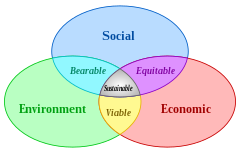
Sustainable development has been described in terms of three dimensions, domains or pillars. In the three-dimension model, these are seen as "economic, environmental and social" or "ecology, economy and equity"; this has been expanded by some authors to include a fourth pillar of culture,[ institutions or governance.

OUR COMMON FUTURE

Our Common Future, also known as the Brundtland Report, from the United Nations World Commission on Environment and Development (WCED) was published in 1987.
Its targets were multilateralism and interdependence of nations in the search for a sustainable development path. The report sought to recapture the spirit of the United Nations Conference on the Human Environment - the Stockholm Conference - which had introduced environmental concerns to the formal political development sphere. Our Common Future placed environmental issues firmly on the political agenda; it aimed to discuss the environment and development as one single issue.

No hay comentarios:
Publicar un comentario